 Connor Finlayson
Why Are Smart TVs So Cheap?
On October 21, a security researcher who posts on X as log4j wrote a short complaint about their TV.
It was a 2025 Samsung. Fairly new. And they kept getting ads that felt a little too targeted.
So they tried to look inside the software. It was encrypted. So, in their words, “zero days it is.” They say they found an unknown security hole, got full control of the TV, and started reading what it was doing.
What they posted next went viral. They claim they found an always-on microphone service, screen tracking, location data and a map of the other devices on their home network. In a follow-up post, they claim that if the TV has no microphone of its own, it looks for one on a connected soundbar or Bluetooth device.
Now, one big caveat before we go any further. None of the microphone claims have been independently confirmed. As of today there is no full write-up, just screenshots on X, and I could not find any public reply from Samsung.
But one part of their story was not new at all. The screen tracking. That part has been studied by university researchers, settled with a US regulator and sued over by a US state.
And it points to a much simpler question. Why are smart TVs so cheap?
Your TV is watching back
Think about a free newspaper. Nobody thinks it’s a scam. Advertisers pay for your attention, so you don’t pay at the door.
Now imagine the newspaper could also see which pages you stopped on. And which videos you watched at home that night. And what was open on your laptop. Then it sold that list to anyone who wanted to sell you something.
That’s closer to what a smart TV can do.
The feature has a dull name: automatic content recognition, or ACR. Your TV regularly takes a sample of what’s on the screen and turns it into a fingerprint. A fingerprint is a short code that stands for that exact frame, like a barcode for a scene. The TV sends that code to a server, the server matches it against a library of shows and ads, and now the company knows what you watched, and when.
How often does it look? In 2024, a team from University College London, Universidad Carlos III de Madrid and UC Davis tested a Samsung TV and an LG TV in the UK and the US. Their paper, Watching TV with the Second-Party, was presented at a major internet research conference. It reports that, based on the companies’ own documents, Samsung captures the screen every 500 milliseconds. That’s twice a second. LG captures every 10 milliseconds. The TVs then send the results in batches, about every minute for Samsung and every 15 seconds for LG.
And this is the part that made me stop.
It doesn’t only watch TV channels. The researchers plugged things into the TV with an HDMI cable, the same cable you’d use for a laptop or a game console. ACR traffic still went out. In their words, ACR “works even when the smart TV is used as a ‘dumb’ external display.”
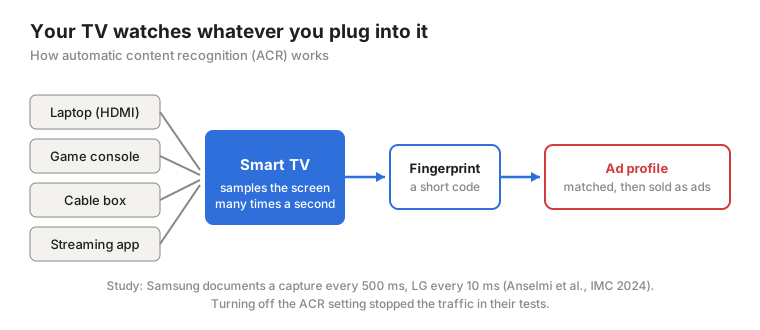
A new class action in California claims the same thing about Samsung. Filed on October 6, 2026, it alleges the TVs capture the screen “roughly twice a second” from “antenna, cable, HDMI, and streaming apps,” according to a summary of the complaint. Those are allegations. Nothing has been proven in court.
But surely you’d have to agree to this?
“I Agree to all”
You did. Probably in about ten seconds.
When you set up a new smart TV, you get a stack of screens. Terms of service. Privacy notice. Viewing information. Interest-based ads. Most people press the big button and get on with their evening.
The California complaint describes Samsung’s version as several notices on one screen with one big button: “I Agree to all.” Turning ACR off again, it says, takes about fifteen clicks across several menus.
Here’s the good news, and it’s real. When the researchers turned ACR off, the tracking stopped. “There is a complete absence of communication with any ACR domains,” the paper says. The switch works. It’s just hidden.
So the next question is obvious. Why would a TV company bother with any of this?
Follow the money
Start with the price. TVs are one of the biggest price drops in modern history. Using US government price data, the American Enterprise Institute calculated that TV prices fell 97% from January 2000 to June 2022.
Most of that is honest progress. Better factories, cheaper screens and brutal competition. But when every brand sells nearly the same panel, it’s very hard to make money on the box itself.
So some of them stopped trying.
And this is the part most people never see, because it’s buried in a financial filing.
The clearest example is Vizio, a big US TV brand. Because it was a public company, it had to show its numbers. In the three months to September 30, 2024, Vizio’s TV and device business had a gross loss of $6.7 million. Gross profit is what’s left after the cost of making the product, before office costs and salaries. So Vizio lost money just building and selling TVs.
In the same three months, its other business, called Platform+, made $115.8 million in gross profit. Platform+ is ads and viewing data.
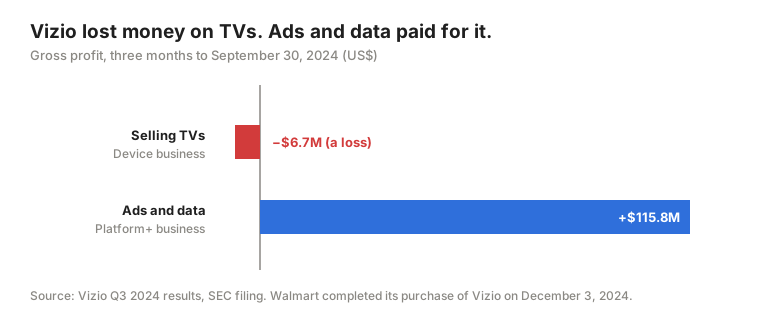
Two months later, Walmart finished buying Vizio for about US$2.3 billion. Walmart said the deal would help advertisers reach customers through its ad business, Walmart Connect. Vizio’s platform had more than 19 million active accounts at the time.
You didn’t buy a cheap TV. You bought a TV that someone else helps pay for, in exchange for watching you.
Which raises an uncomfortable question. Is any of this even legal?
This has happened before
Sometimes. But this isn’t a new trick, and it hasn’t always been legal.
In 2017, Vizio agreed to pay US$2.2 million to the US Federal Trade Commission and the State of New Jersey. The charge: it collected viewing histories from 11 million TVs without people’s consent. The court order made Vizio ask clearly and get permission first.
Then, in December 2025, Texas sued Sony, Samsung, LG, Hisense and TCL. The state alleged the TVs take screenshots every 500 milliseconds without people knowing, BleepingComputer reported. Texas Attorney General Ken Paxton called ACR “an uninvited, invisible digital invader.”
Samsung settled in February 2026. It agreed to add clear disclosures and consent screens before ACR collects data from Texans, FOX 7 Austin reported. Samsung said the deal “affirms what Samsung has said since this lawsuit was filed – Samsung TVs do not spy on consumers.” LG settled in May 2026 and agreed to a pop-up that explains the data collection and gives a clear way to opt out, FOX 7 reported. Neither settlement bans ACR. And both cover Texas.
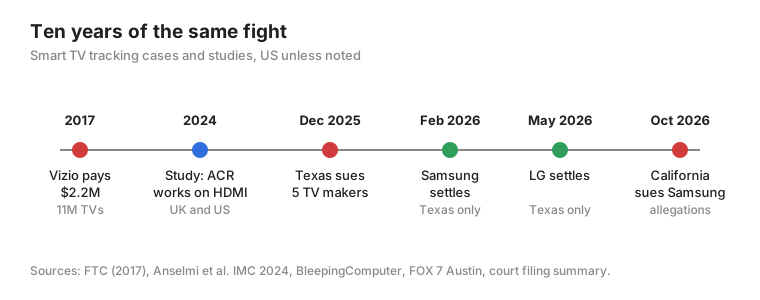
So the law moves slowly, and mostly in one state. If nobody is going to switch this off for you, who will?
What you can do tonight
You will. And you don’t need to root anything. Most of the protection is in the settings menu.
1. Turn off ACR. The name is different on every brand, so look for these. The Markup and Malwarebytes have step-by-step guides.
- Samsung: Viewing Information Services
- LG: Live Plus
- Vizio: Viewing Data
- Roku TVs: Use info from TV inputs
- Sony and Google TV: Samba Interactive TV
While you’re in there, turn off interest-based ads, reset your advertising ID, decline optional agreements and turn off voice features you don’t use.
2. Put smart devices on their own network. Most home routers have a guest network. Put the TV, cameras and smart speakers on it. These devices don’t get security updates often. If one gets hacked, it shouldn’t be able to see your laptop.
3. Block trackers for the whole house. A DNS filter blocks a device from finding the tracking servers in the first place. NextDNS has a free plan and a “Native Tracking Protection” setting for brands like Samsung, Amazon and Roku. Pi-hole does the same thing on a small computer at home. Then look at the logs. You’ll see how often your TV phones home. If an app breaks, allow that one domain again.
One honest limit: a DNS filter only blocks what it knows about, and some devices try to get around it. The ACR setting is still your first step.
But fixing your own TV doesn’t answer the bigger question.
So, is it a scam?
Go back to that researcher’s living room. The always-on microphone may turn out to be less dramatic than it looked. Some engineers on Hacker News point out that many voice devices listen only for a wake word on a small chip, and Samsung sells sound detection for things like a barking dog as a feature.
But the part nobody disputes is the business model. Selling the TV doesn’t pay. Selling what you watch on it does. That’s why TVs got cheap. And it’s why the switch that turns it off sits fifteen clicks deep instead of on the first screen.
There are real trade-offs here. Make ACR opt-in everywhere, and TV prices might go up, because the ad money pays for some of that discount. Ban it, and you lose the cheap TV in the Black Friday flyer. Do nothing, and every new screen arrives with a stranger already sitting on the couch.
If you’d pay $200 more for a TV that didn’t watch you back, why isn’t anyone selling one?
And if they did, would you actually buy it?
Sources
- log4j on X: original post about the 2025 Samsung TV
- log4j on X: follow-up post about connected microphones
- Anselmi et al.: Watching TV with the Second-Party: A First Look at Automatic Content Recognition Tracking in Smart TVs (IMC 2024)
- Captain Compliance: Summary of Tillery, Walsh and Rosenberg v. Samsung Electronics America
- AEI: Chart of the day (or century?)
- Vizio: Third quarter 2024 results (SEC filing)
- Walmart: Walmart completes acquisition of VIZIO
- FTC: VIZIO to pay $2.2 million to FTC, State of New Jersey to settle charges it collected viewing histories on 11 million smart televisions without users’ consent
- BleepingComputer: Texas sues TV makers for spying on users, selling data without consent
- FOX 7 Austin: Samsung updates TV data consent settings after Texas sues over ‘spying’
- FOX 7 Austin: LG to alert smart TV users of data collection following Texas privacy settlement
- The Markup: Your smart TV knows what you’re watching
- Malwarebytes: Samsung TVs stop spying on viewers in Texas. Here’s how to disable ACR anywhere
- Hacker News: Root shell on Samsung TV (discussion)