 Connor Finlayson
AI labs want to be worth trillions. Open models give away the recipe.
This week, two AI stories landed one day apart.
On October 22, TechCrunch reported that OpenAI is working to raise up to $30 billion at a $1.25 trillion valuation. The same report says Anthropic, the company behind Claude, wants a $1.5 to $2 trillion valuation when it lists on the stock market.
The next day, the Chinese AI lab Moonshot released Kimi K3.1 Pro. On one coding test, it scored almost the same as Claude’s best model. It costs half as much to use. And Moonshot says it will release the model’s files by November 4, so you can run it yourself.
So here’s the question I keep coming back to: how can two companies be worth trillions when something almost as good is about to be free to download?
To answer that, it helps to know what “open” and “closed” actually mean.
Closed vs open: the restaurant and the recipe
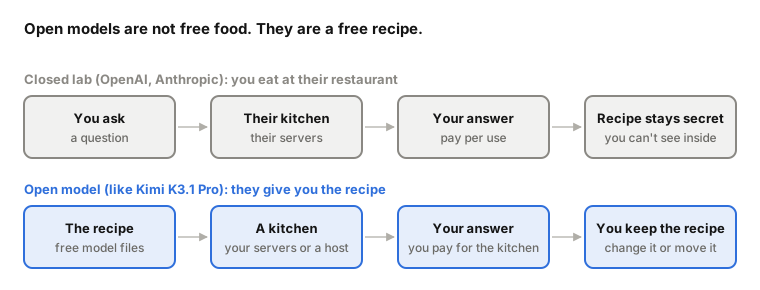
Think of a closed AI model like a restaurant. ChatGPT and Claude work this way. You send in your order, their kitchen cooks it, and you get your meal. You pay for every meal, and you never see the recipe.
An open model is different. The lab gives you the recipe. In AI, the “recipe” is the model’s files (called “weights”). You can download them, cook at home, change the recipe, and nobody can take it away from you.
But here’s the part people miss: open doesn’t mean free. The recipe is free, but you still need a kitchen. Kimi K3.1 Pro builds on a model with “nearly 3 trillion parameters” (the settings a model learns during training). A recipe that big needs a huge kitchen: rooms full of expensive computers. So most people will still pay someone to cook it for them. The difference is that you get to choose the kitchen.
Picture your local pizza place, with a chatbot on its website that takes orders. If that chatbot runs on a closed model, the pizza place pays the restaurant every time a customer chats. With an open model, it could pick a cheaper kitchen, or move to a new one later, and keep the same recipe.
How good are open models now?
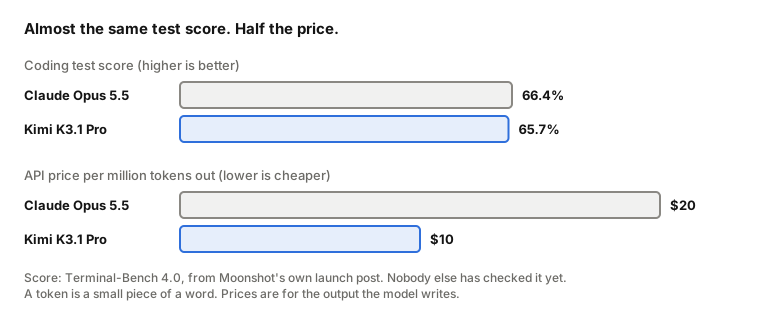
Very good. On a coding test called Terminal-Bench 4.0, Moonshot says Kimi K3.1 Pro scored 65.7%. Anthropic’s Claude Opus 5.5 scored 66.4%, and OpenAI’s GPT-6 Astra scored 58.2%.
Then there’s the price. AI is priced per “token”, which is a small piece of a word. Kimi K3.1 Pro costs $2 per million tokens in and $10 per million out. Claude Opus 5.5 costs $4 in and $20 out. That’s half the price.
Developer Simon Willison put it simply: “This is the first time a (soon-to-be) open weight model has scored this highly against the frontier.”
Two big caveats. First, those scores come from Moonshot itself, and The Next Web notes they “haven’t been independently verified”. Second, the recipe isn’t out yet. Moonshot says “The full model weights will be released by Nov 4.” Also, a lower price per token doesn’t always mean a cheaper job, because some models use more tokens to get to an answer.
So why would anyone pay for the restaurant?
Here’s my take: trust. OpenAI and Anthropic have a lot more trust in the market than an open Chinese model. If you run a big company or a government agency, you want a supplier you can sign a contract with, call when something breaks, and hold to account. I think most corporations, and especially government agencies, will likely always choose a big lab.
That trust question is real. In July, the White House accused Moonshot of using banned Nvidia chips and copying an Anthropic model to build Kimi K3, The Next Web reports, but it didn’t publish evidence.
The big labs also make real money. Anthropic’s revenue run rate (what it would earn in a year at its current pace) topped $65 billion by the end of July, up from about $9 billion at the end of 2025. OpenAI’s was almost $50 billion in September. The two count sales through cloud partners differently, so it isn’t a perfect comparison.
But running the restaurant is very expensive. Compute (the giant computers that train and run AI) is the biggest bill, and growth costs a lot too. Based on an investor presentation seen by the Financial Times, OpenAI “expects to spend $278 billion more money than it generates between 2026 and 2030”. That’s why the labs keep raising money.
And this is the part I find most interesting. They aren’t only competing with each other. They’re competing with open models too.
My take: everyone has a price
The real question isn’t whether big companies trust the big labs. They do. The question is: where’s the cutover?
I think a big AI price hike is coming, and I deliberately say when, not if. Right now, I don’t think your monthly subscription pays for the AI you use. A company that spends more than it earns can’t keep that up forever.
When prices go up, every business will ask the same question: is the trusted restaurant still worth it, or is it time to take the recipe home? For as long as open models are around, that choice will exist. And in my opinion, everyone has a price.
What this means for you
- Don’t get locked in. If someone builds an AI tool for your business, ask if it can switch models later. It should be a settings change, not a rebuild.
- Know your AI bills. Write down what you pay each month, so you notice when the price changes.
- Try a cheaper model for simple jobs. For questions like “what time do you close?”, you may not need the most expensive model.
- Ask where your data goes. Before you send customer details to any AI model, ask where it runs and who can see the data. That matters more than the price.
The short version
OpenAI and Anthropic want to be worth trillions. Open models like Kimi K3.1 Pro now come close for half the price, and they give you the recipe.
I think big companies will stay with the big labs because of trust. But when AI prices go up, open models will be the alternative. And everyone has a price.
Sources
- TechCrunch: OpenAI working on new $30B raise at $1.25T valuation ahead of IPO
- Kimi: Kimi K3.1 Pro tech blog
- The Next Web: Moonshot releases Kimi K3.1 Pro and says it cut its hacking skills
- Simon Willison: Introducing Kimi K3.1 Pro
- Claude: Pricing
- Reuters (via The Star): Anthropic revenue run rate tops $65 billion, source says
- Reuters (via Zawya): OpenAI’s September annualized revenue nears $50 bln
- Tom’s Hardware (via Yahoo Finance): OpenAI projections point to a massive $278 billion cash burn through 2030